

A single unexplained bank deposit of £1,000 can be the sole reason for a UK visa refusal, even if your total balance far exceeds the minimum threshold. You've likely spent hours gathering evidence, yet the fear that a minor clerical oversight or a vague "lack of strong ties" could derail your travel plans remains a constant source of stress. It's a common frustration for applicants from India and Pakistan who find that meeting the standard uk visa requirements involves more than just filling out a form; it requires a strategic presentation of your entire life's stability.
We've designed this comprehensive guide to act as your professional roadmap through the 2026 immigration landscape, grounded in the high standards of OISC regulation. You'll gain a clear understanding of how to audit your own financial records for "red flags" and how to document your social and economic commitments with absolute clarity. We'll break down the specific evidence needed to satisfy Home Office caseworkers, providing a bespoke framework that transforms a complex legal process into a manageable, step-by-step path toward your successful visa grant.
Key Takeaways
- Understand why the Home Office prioritizes the verifiable source of your wealth over a simple bank balance to avoid common refusal triggers like unexplained large deposits.
- Learn how to strategically demonstrate your economic and social ties to ensure the Entry Clearance Officer recognizes your genuine intent to return home.
- Identify the critical distinction between mandatory and supporting documentation within our comprehensive 2026 checklist to ensure a complete and compliant submission.
- Discover how a proactive risk assessment can help you navigate complex uk visa requirements and protect your future travel history from the impact of a refusal.
- Gain expert insight into Appendix V of the 2026 Immigration Rules to understand the subjective criteria used by officials when evaluating your eligibility.
Navigating UK Visa Requirements in 2026: Why Eligibility is Only the Beginning
The landscape of UK immigration has undergone a seismic shift as we move through 2026. The Home Office has finalized its transition to a "digital by default" system, replacing physical biometric residence permits with eVisas. For applicants navigating uk visa requirements, understanding Appendix V of the Immigration Rules is the essential baseline. However, technical eligibility doesn't guarantee a successful outcome. The final decision rests with the Entry Clearance Officer (ECO), who evaluates every application through a lens of risk and intent. This subjective assessment is often where well-prepared applications fail because they focus on checklists rather than the underlying logic of the rules.
A thorough UK visa policy overview reveals that while the Electronic Travel Authorisation (ETA) system has expanded to include more nationalities, visa-national countries like India, Pakistan, and Nigeria still face rigorous manual scrutiny. The expansion of the ETA system in late 2025 has streamlined travel for some, but it has also allowed the Home Office to redirect its investigative resources toward high-volume visa application centers. Our OISC-regulated consultants have observed that this shift has led to a more forensic analysis of financial documents and personal circumstances for those still required to submit full visa applications.
The Core Eligibility Criteria
Appendix V defines 'Permitted Activities' with legal precision. While you can attend business meetings or visit family, you cannot undertake paid work or access public funds. The 6-month rule remains a common pitfall; staying for the maximum duration frequently triggers a "frequent visitor" red flag in future applications. The 'Genuine Visitor' test is the primary hurdle. It requires proving, beyond a balance of probabilities, that you'll leave the UK at the end of your visit. Without bespoke evidence that anchors you to your home country, even a high bank balance won't prevent a refusal under the uk visa requirements framework.
Regional Nuances for Global Applicants
Applicants in New Delhi, Islamabad, and Kingston face unique challenges. In 2026, the ECO's focus on local economic conditions has intensified. They don't just look at your absolute wealth; they analyze the "pull factors" of the UK against the "push factors" of your home country. If your income doesn't align with the local economic context or if your "ties" are deemed weak, the risk of refusal increases. Local document verification standards are stricter than ever. Verification teams in regional hubs now use advanced cross-referencing with local tax authorities to ensure the integrity of every submission.
The Financial Credibility Hurdle: Meeting the 2026 UK Visa Maintenance Requirements
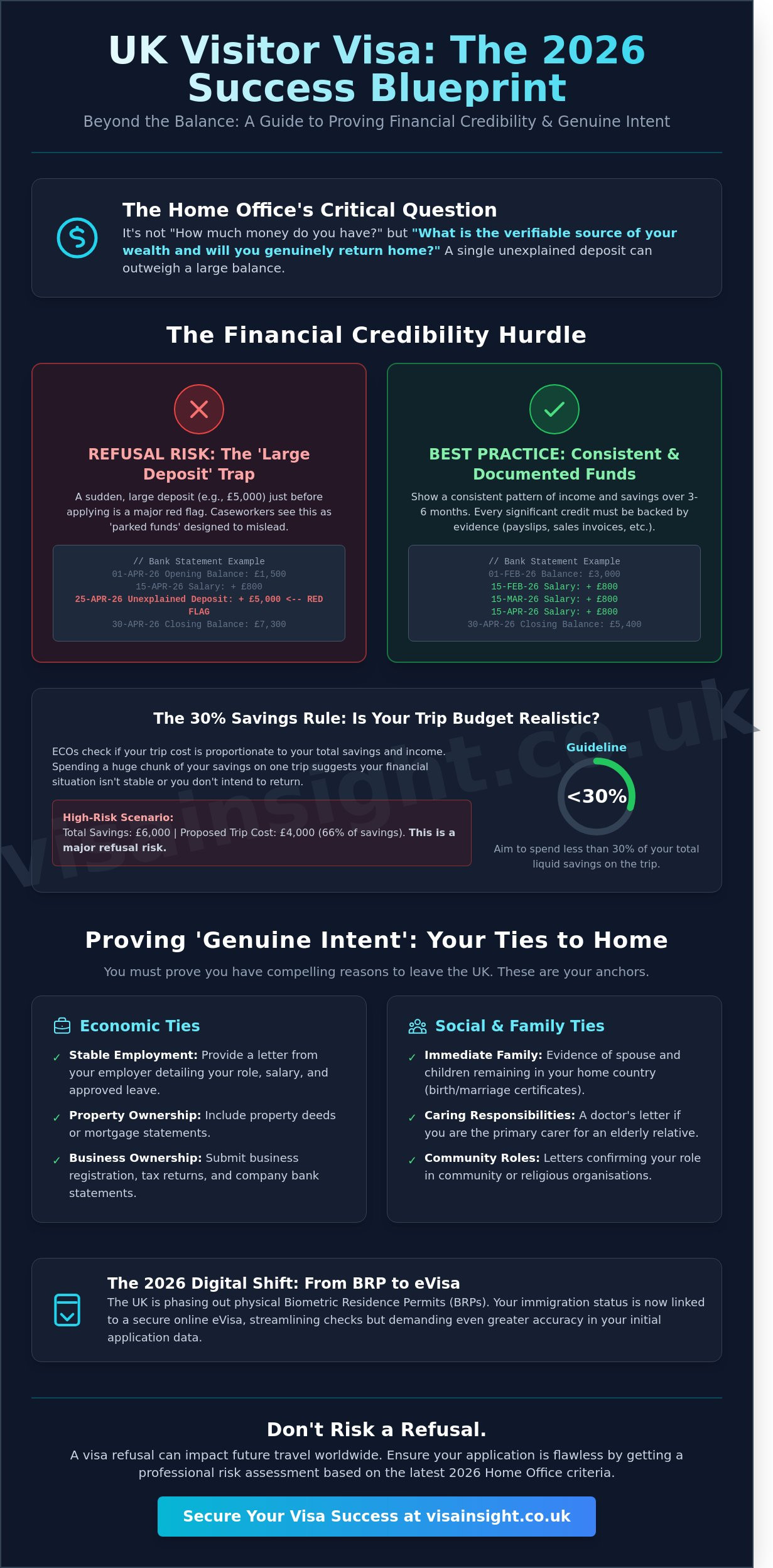
Meeting the uk visa requirements in 2026 involves more than just showing a healthy bank balance. The Home Office has intensified its scrutiny of the 'source of wealth,' moving away from simple closing balances to a deep-dive analysis of how funds were accumulated. Financial Credibility is the alignment of banking history with lifestyle. If your bank statement shows a sudden influx of £5,000 just weeks before applying, caseworkers often view this as 'parked funds' intended to deceive the Entry Clearance Officer. This 'Large Deposit' trap remains a leading cause of refusals for applicants from South Asia, where informal family loans are common but often undocumented.
A realistic travel budget must balance income against expenditure. You shouldn't spend more than 30% of your total liquid savings on a single trip. If your declared monthly income is £800, claiming a £4,000 holiday budget is seen as a significant red flag. For those relying on third-party sponsorship, the sponsor must provide a signed undertaking and proof of their own financial capacity. This ensures they can support you without accessing public funds. Reviewing the official Standard Visitor visa information helps clarify these baseline expectations, but a bespoke approach is often necessary for complex financial profiles.
Required Financial Documentation
While the 3-month standard was common in previous years, current 2026 trends suggest providing 6 months of history offers much better protection against scrutiny. For applicants in India and Pakistan, consistency between bank statements and Income Tax Returns (ITR) is non-negotiable. Business owners must demonstrate corporate solvency through audited accounts and prove their personal right to withdraw funds without destabilizing the company's 2026 growth projections. Ensuring these documents meet the latest uk visa requirements is a core part of our compliance check.
Financial Red Flags to Avoid
Sudden 'top-ups' are the most frequent reason for visa denials in the current regulatory climate. If you receive a significant transfer, you must provide a verifiable paper trail, such as a property sale deed or a matured fixed deposit receipt. Discrepancies between your declared monthly salary and the actual credits in your account suggest undisclosed income or financial instability. Our OISC-registered consultants provide a comprehensive audit of your financial profile to ensure every transaction aligns with your professional narrative and lifestyle evidence.
Proving Genuine Intent: How to Demonstrate Strong Ties to Your Home Country
The Home Office operates on a "genuine intention" test. Every Entry Clearance Officer (ECO) begins their assessment with the assumption that an applicant might intend to overstay their visit. This isn't a personal judgment; it's a procedural safeguard rooted in Appendix V of the Immigration Rules. To successfully meet uk visa requirements, you must provide objective evidence that outweighs this skepticism. While the new ETA system simplifies travel for some, visa-nationals must still navigate rigorous UK entry requirements to prove they'll return home.
Economic ties generally carry more weight than social ones in 2026. A stable income and local assets represent a tangible loss if you don't return, which provides the ECO with a logical reason for your compliance. For applicants from high-risk regions who fit the "young, single, unemployed" profile, the challenge is steeper. Home Office data from 2023 suggests that this demographic faces higher refusal rates due to a perceived lack of "economic establishment." If you fall into this category, you must emphasize your future prospects, such as ongoing higher education or a confirmed job offer starting after your trip.
Property ownership acts as a powerful anchor. A title deed or a long-term lease agreement in your name demonstrates a physical and financial commitment to your home country. If you don't own property, focus on your professional and family obligations to build a bespoke evidence portfolio that reflects your specific circumstances.
Evidence of Employment and Career
Your "No Objection Certificate" (NOC) is the cornerstone of a professional application. It shouldn't just be a simple permission slip. To be valid, it must be on official letterhead and include your job title, current salary, and the specific dates of your approved leave. Crucially, it must state that your position is being held for you upon your return. If you're self-employed, you need to prove your business is a "going concern." Provide 24 months of tax filings and business bank statements to show that the entity requires your active management to remain profitable.
Family and Social Obligations
Social ties involve proving that others depend on your presence. If you're a primary caregiver for elderly parents or young children, provide medical certificates or school enrollment records that list you as the legal guardian. Community roles, such as being a trustee for a local charity or a long-term resident with 10 or more years in the same district, also add layers of credibility. For a detailed breakdown of the documentation required, see our guide on how to prove strong ties to your home country. These connections demonstrate that your life is firmly rooted outside the UK, making a uk visa requirements approval much more likely.
Your Comprehensive UK Standard Visitor Visa Document Checklist
Precision is the cornerstone of a successful application. Meeting uk visa requirements involves more than just filling out a digital form; it requires a curated portfolio of evidence that addresses the Home Office’s specific eligibility criteria under Appendix V. Our experience as OISC-regulated advisors shows that most delays stem from incomplete or poorly formatted evidence.
Mandatory Identification and Travel Documents
- Current Passport: Your document must be valid for the duration of your stay and contain at least one blank page for the visa vignette.
- Travel History: Provide all expired passports from the last 10 years. Evidence of travel to OECD countries, such as the USA, Canada, or Australia, acts as a powerful indicator of compliance and significantly bolsters your credibility.
- Tuberculosis (TB) Test: For 2026, residents of India, Pakistan, and other listed countries must provide a valid TB certificate from a Home Office approved clinic if they've resided there for six months or more.
- Travel Intentions: The Home Office doesn't require paid flight or hotel bookings. Instead, they request a clear itinerary. Providing "intentions" rather than "confirmed bookings" prevents financial loss if processing exceeds the standard 15-day window.
Supporting Evidence for Specific Purposes
Business visitors must submit a formal invitation letter from a UK-based organization. This letter should outline the specific permitted activities you'll undertake, such as attending meetings or negotiating contracts. You must also provide evidence of your current employment and commercial ties in your home country to prove you're a genuine visitor.
For family visits, the burden of proof lies in demonstrating the relationship. Use birth certificates, marriage licenses, or household registers. You must also include the inviter’s UK passport copy or stay permit. It's vital to consult the UK visitor visa refusal reasons 2026 to understand which supporting documents, like unverified cash deposits, often trigger a rejection.
A bespoke cover letter is essential to pre-empt Entry Clearance Officer (ECO) concerns. It should frame your narrative, explaining the purpose of your trip and your ties to your home country. If any document isn't in English or Welsh, you must provide a certified translation. This translation must include the date, the translator's full name and signature, and their contact details to meet 2026 compliance standards.
If you're unsure how to structure your evidence to meet complex uk visa requirements, our expert team can help. Contact Visa Insight for a bespoke document assessment to maximize your chances of success.
Minimising Refusal Risks: Why a Risk Assessment is Your Best Investment
A UK visa refusal carries a heavy burden that extends far beyond the immediate loss of the application fee. It establishes a permanent record within the Home Office database. This record can complicate future travel not just to Britain, but to other Five Eyes nations such as Canada, Australia, and the USA. When you calculate the cumulative cost of visa fees, priority processing, and non-refundable flight bookings, a single rejection often results in financial losses exceeding £1,000.
Understanding the distinction between general legal advice and a technical risk assessment is vital. While legal advice provides a broad framework, a risk assessment is an analytical audit of your specific evidence. Our 48-hour analytical report identifies financial red flags, such as "funds stuffing" or inconsistent income patterns, that frequently lead to mandatory or discretionary refusals. By identifying these "weak links" before submission, you can address them with credible explanations or additional documentation.
The Visa Insight Evaluation Process
Our evaluation methodology mirrors the logic used by Home Office caseworkers. We analyze your financial consistency to ensure your disposable income aligns with your proposed trip costs. Meeting the uk visa requirements requires a strategic look at your personal circumstances. We focus on three critical areas:
- Economic Ties: Verifying that your employment or business income is verifiable and stable.
- Social Ties: Documenting family and community obligations that prove your intention to return home.
- Financial Credibility: Identifying any large deposits that lack a clear, documented source.
A £119 investment in a bespoke report provides the clarity needed to meet uk visa requirements with precision. It's a pragmatic step to protect your travel history and your finances.
Submitting with Confidence
The final stage of the process involves ensuring your online application form is a perfect mirror of your supporting documents. Discrepancies in dates or salary figures are common triggers for refusal. Once your digital application is submitted, you'll attend an appointment at a VFS Global or TLScontact center. During this session, staff will capture your biometrics, including fingerprints and a digital photograph.
Standard processing times generally hover around 15 working days, though it's wise to track your application status through the official partner portal. If you're applying from India or Pakistan, demand is consistently high, so early preparation is your greatest advantage. You'll receive an email notification once a decision is made, after which your passport will be ready for collection or courier delivery.
Take the Next Step Toward Your UK Residency
Navigating the complex uk visa requirements for 2026 demands more than just a basic document checklist. You've seen how critical it's to establish financial credibility and demonstrate genuine ties to your home country to avoid the common pitfalls of a standard visitor application. Success relies on precision and a deep understanding of current Home Office compliance standards. Instead of leaving your future to chance, you can gain clarity through an expert-led evaluation of your specific circumstances.
Before you commit to non-refundable government fees, it's vital to identify potential vulnerabilities in your submission. Our OISC-registered consultants provide a bespoke solution to bridge this gap. You can secure your UK visa success with a professional Risk Assessment Report for £119. This comprehensive report is delivered within 48 hours and offers an independent assessment of your financial credibility. It identifies specific refusal risks before you pay the Home Office fees, ensuring your application is as robust as possible. We're here to help you move forward with confidence and achieve your goal of visiting or settling in the UK.
Frequently Asked Questions
What are the main UK visa requirements for 2026?
To satisfy the uk visa requirements in 2026, you must provide a valid passport and evidence that you're a genuine visitor who'll leave the UK at the end of your stay. You'll need to demonstrate financial sufficiency to cover all travel and maintenance costs without working or accessing public funds. Comprehensive documentation, including a detailed itinerary and proof of accommodation, is essential for a successful application under current Home Office rules.
How much money do I need in my bank account for a UK visitor visa?
The Home Office doesn't mandate a specific minimum balance, but your funds must realistically cover your entire trip. Most successful applicants show a balance that covers their flights, accommodation, and approximately £100 to £150 in daily spending money. If your planned 10 day visit costs £2,500, your bank statements should consistently reflect this amount alongside your regular income and expenditure patterns.
Can I apply for a UK visa if I have been refused before?
You can certainly reapply after a refusal, provided you address the specific grounds for the initial rejection. It's vital to submit a bespoke application that provides fresh evidence to satisfy the caseworker's previous concerns. Our OISC regulated consultants note that roughly 25% of successful applications come from individuals who were previously refused but later provided more comprehensive documentation regarding their eligibility.
Is a flight ticket required before applying for a UK visa?
You don't need to purchase a flight ticket before you apply for your visa. The official Gov.uk guidance explicitly advises against making non-refundable travel arrangements until you've received a positive decision. Instead of a confirmed ticket, you should provide a clear travel plan that outlines your intended dates and the specific locations you plan to visit during your stay in the UK.
How do I prove my ties to my home country in India or Pakistan?
Proving ties to India or Pakistan involves documenting your economic and social commitments that necessitate your return. You should provide an employment letter detailing your salary and approved leave, or business registration papers if you're self-employed. Additionally, presenting property deeds or family documents, such as marriage certificates, helps establish a tailored profile that demonstrates your strong incentive to leave the UK as planned.
How long does it take to get a decision on a UK Standard Visitor visa?
Standard Visitor visa decisions are typically processed within 15 working days once you've attended your appointment at the visa application centre. During peak travel seasons in 2025, some applicants experienced wait times extending to 21 or 30 days. It's advisable to check the latest processing data on the Home Office website to ensure your application is submitted well in advance of your departure.
What counts as a 'large deposit' in a UK visa application?
A large deposit is any sum of money credited to your account that's inconsistent with your declared income or usual financial activity. For example, if your monthly salary is £800, a sudden deposit of £4,000 will be flagged by caseworkers as suspicious. You must provide a documented explanation for such funds, such as a property sale record or a gift letter, to ensure compliance with financial transparency rules.
Do I need a solicitor to apply for a UK visitor visa?
While a solicitor isn't a legal requirement, seeking professional guidance can significantly reduce the risk of a refusal. A bespoke service from an OISC regulated firm ensures that your application is meticulously prepared and adheres to the complex uk visa requirements. Given that the Home Office refused over 13% of visitor visa applications in recent cycles, expert oversight provides a seamless and more reliable path to success.