

For many applicants, a bank statement showing the required balance is no longer a guarantee of approval; it's merely the starting point for a rigorous UK visa financial credibility check. You likely recognize that meeting the minimum threshold is mandatory, yet the fear of a caseworker flagging a specific deposit from October 2025 as "unexplained" remains a significant burden. This subjectivity often leads to unnecessary refusals, even for those with genuine funds. We know that the uncertainty surrounding what constitutes a "large deposit" can make the process feel like a gamble with your future.
We understand the stress that comes with documenting informal income or explaining complex transfers to a skeptical official. As an OISC-regulated firm, we've seen how a lack of clarity can derail even the most promising applications. By reading this guide, you'll master the complexities of UKVI financial assessments and learn how to prove your economic credibility beyond just your bank balance. We provide a bespoke roadmap to identifying red flags before you submit, ensuring your financial story is presented with the precision and integrity required for a successful outcome in 2026.
Key Takeaways
- Understand why meeting mandatory financial thresholds is only the beginning of the evaluation, as we decode the subjective criteria used during a UK visa financial credibility check.
- Gain clarity on the critical distinction between 'Source of Wealth' and 'Source of Funds' to ensure your application survives the Home Office's rigorous digital scrutiny.
- Implement a professional pre-submission framework to audit your financial history and substantiate informal income through bespoke documentation and third-party evidence.
- Learn how a meticulous Visa Insight Assessment provides a comprehensive breakdown of your financial consistency to identify and mitigate refusal risks before submission.
Understanding the UK Visa Financial Credibility Check vs. Financial Requirements
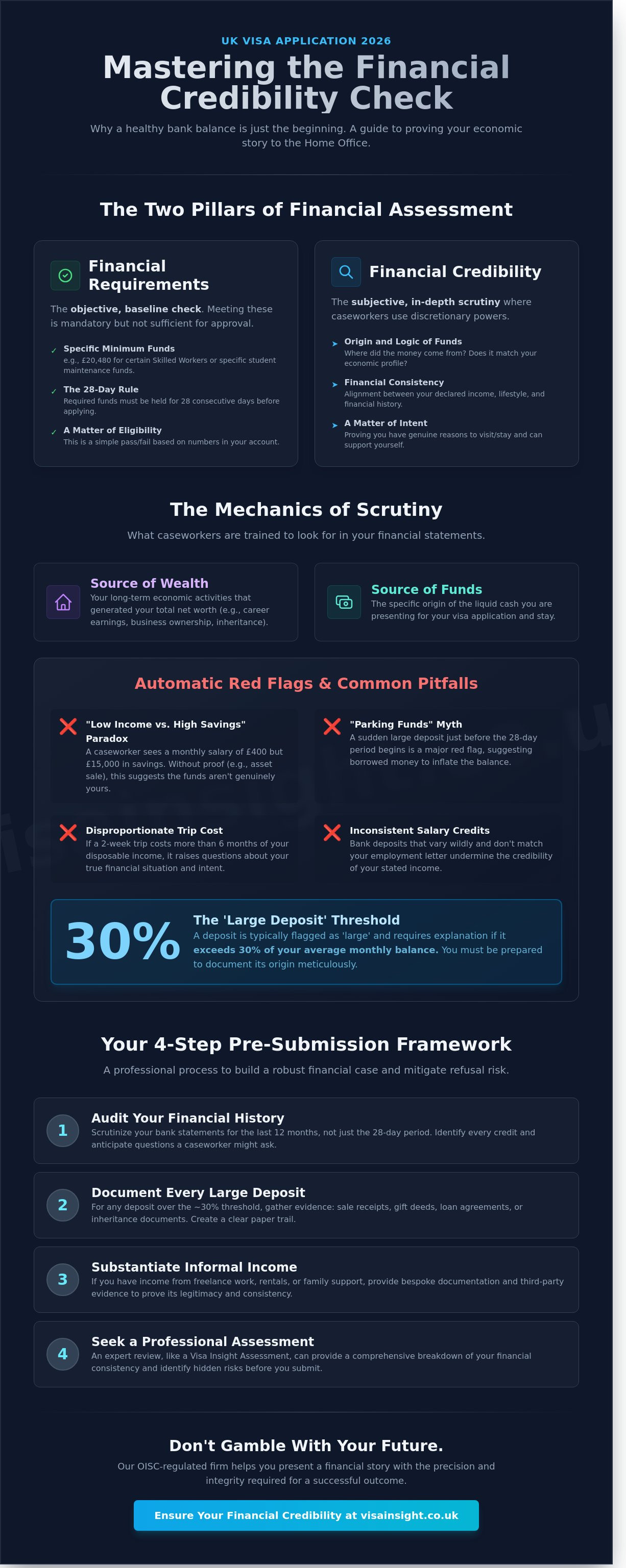
Securing a UK visa in 2026 requires more than just a healthy bank balance. Applicants must distinguish between meeting the mandatory financial thresholds and passing the subjective UK visa financial credibility check. While Appendix Finance of the Immigration Rules sets out the specific amounts required for various routes, such as the £20,480 minimum for certain skilled workers or the specific maintenance funds for students, these figures represent the floor rather than the ceiling of the assessment. Financial credibility is the alignment between an applicant's declared income, lifestyle, and requested stay duration.
The 28-day rule, which mandates that required funds must be held for a consecutive period before an application, serves as a technical baseline. However, Home Office caseworkers now look beyond this timeframe to scrutinize the origin of those funds. This shift toward rigorous scrutiny stems from the broader UK immigration policy, which prioritizes the integrity of the points-based system. Meeting the numerical requirement is a matter of eligibility, but proving credibility is a matter of intent. Caseworkers use discretionary powers to decide if the financial evidence presented reflects a logical and sustainable economic background.
The 'Genuine Visitor' Test
The Home Office uses financial patterns to evaluate the 'Genuine Visitor' requirement. If an applicant's financial history doesn't support their stated plans, they risk a refusal under paragraph V 4.2 of Appendix V. Caseworkers are trained to identify the "low income vs. high savings" paradox. For instance, an applicant claiming a monthly salary of £400 who suddenly presents £15,000 in savings without a documented inheritance or asset sale will face intense skepticism. The primary concern is that the applicant may intend to overstay and work illegally to recoup the costs of their trip. Refusal codes often cite a lack of "economic ties" to the home country, suggesting the applicant has more reason to stay in the UK than to return.
Why Bank Balances Alone Are Deceptive
A static bank balance is often a poor indicator of true financial health. The "parking funds" myth leads many to believe that a sudden influx of cash just before applying will satisfy the Home Office. In reality, large, unexplained deposits trigger an automatic red flag. Caseworkers calculate disposable income by comparing the applicant's monthly net earnings against their regular living expenses. If the proposed cost of a two-week UK trip exceeds six months of an applicant's total disposable income, the UK visa financial credibility check will likely fail. The Home Office distinguishes between available funds, which might be borrowed or "parked," and credible wealth, which is wealth accumulated through verifiable, legal means over a logical period. Success depends on showing that the expenditure is proportionate to the applicant's actual financial circumstances.
The Mechanics of Scrutiny: What Caseworkers Look For in 2026
The UK visa financial credibility check has evolved into a data-centric process that prioritizes transparency and logical financial behavior. Caseworkers now distinguish sharply between the 'Source of Wealth' and the 'Source of Funds.' While the source of wealth refers to the long-term activities that generated your overall net worth, such as years of professional employment or business ownership, the source of funds focuses on the specific origin of the liquid cash you intend to use for your UK stay. By 2026, UKVI has fully integrated automated verification systems that cross-reference bank data with international financial intelligence units. This digital shift means that inconsistencies are flagged instantly by algorithms before a human caseworker even opens the file.
Income consistency is the benchmark of a successful application. Caseworkers perform a granular analysis to ensure that every credit entry on your bank statement aligns with your submitted employment letters and tax returns from the previous 12-month period. If you claim a specific monthly salary, but your bank deposits vary wildly without explanation, the risk of refusal increases. UKVI caseworkers are trained to look for 'unexplained' credits that do not match the applicant's profile.
Handling 'Large Deposits' and Windfalls
A deposit is generally flagged as 'large' if it exceeds 30% of the average monthly balance maintained over the preceding six months. To mitigate risk, you must provide a meticulous audit trail for any significant influx of capital. For property sales completed in 2025 or 2026, this requires the formal sale contract and a completion statement from a licensed solicitor. Inheritance requires a grant of probate and a letter from the executor of the estate. Informal loans from family members are particularly dangerous; caseworkers often view these as 'funds for show' rather than genuine savings. For those pursuing education, meeting the official student visa financial requirements involves proving that these funds have been held for a consecutive 28-day period without dropping below the required threshold.
Third-Party Support and Sponsorship
Relying on a UK-based sponsor does not exempt you from the credibility check. In fact, it often invites deeper scrutiny into your own economic circumstances. You must prove a 'genuine relationship' with the sponsor through marriage certificates, birth certificates, or a documented history of financial support. The Home Office remains skeptical of 'gifts' from distant relatives or friends that lack a logical basis. When comparing these requirements to other routes, such as the UK Spousal Visa Cost 2026, it becomes evident that proving your own ties to your home country is just as vital as the sponsor's wealth. If the caseworker suspects you won't return home because you have no personal assets, the sponsor's high income will not save the application. Our OISC-regulated experts suggest a bespoke document checklist to ensure your specific financial narrative is airtight.
Regional Financial Nuances: From India to the United States
The Home Office adopts a risk-based approach that varies significantly depending on the applicant's nationality. A UK visa financial credibility check for a resident in Mumbai differs vastly from one in New York. While the fundamental requirement of self-sufficiency remains constant, the evidentiary burden shifts based on local economic structures and historical compliance data. Our OISC-regulated consultants frequently observe that failure to account for these regional nuances is a leading cause of avoidable refusals.
South Asian Context: India, Pakistan, and Bangladesh
Applicants from India, Pakistan, and Bangladesh often face intense scrutiny regarding the source of their funds. Agricultural income presents a specific hurdle because it's frequently cash-based and informal. To satisfy a caseworker, you must provide land ownership records, sales receipts, and bank statements showing these deposits over a consistent period. Affidavits of income are rarely sufficient on their own. Instead, local tax compliance, such as the Indian Income Tax Return (ITR), serves as the primary credibility marker. For those exploring a Parents Visa for UK 2026, proving these financial ties is vital to show that elderly relatives have the means and intent to return home. While Chartered Accountant (CA) Reports were once a standard submission, in 2026, they're viewed as supplementary. Caseworkers now prioritize primary bank data and verifiable government tax filings over third-party summaries.
High-Income and Regulated Markets: US and EU
Nationalities on the "Differential Evidence" list, including the US, France, and Germany, benefit from reduced documentation requirements at the point of submission. However, this doesn't grant total immunity from a UK visa financial credibility check. The Home Office still performs these checks if they suspect the applicant's economic ties to their home country are weak. High wealth in Hong Kong or France doesn't guarantee success if the applicant can't prove their life is too established to abandon. For digital nomads and the self-employed in the US or Germany, standard bank statements often fall short of proving stability. You should provide audited accounts or tax transcripts to align with the official UK government financial evidence guidelines. These rules ensure that even low-risk applicants demonstrate a consistent and legitimate financial history. Caseworkers look for a pattern of earnings that justifies the planned stay in the UK, ensuring the move is economically logical and sustainable.
A Pre-Submission Framework for Financial Credibility
Adopting a clinical approach to your records is essential before the Home Office begins their assessment. A successful UK visa financial credibility check relies on your ability to present a logical, transparent financial history that leaves no room for caseworker doubt. This five-step framework provides a structured method to prepare your evidence to the 2026 standard.
- Step 1: The 6-Month Bank Statement Audit. Scrutinize every transaction. You must identify every credit entry that exceeds 20% of your total monthly income. These "large deposits" are the primary focus of Home Office scrutiny.
- Step 2: Third-Party Verification. Cross-reference every identified credit with a tangible document. Caseworkers require independent proof such as a payslip, a formal invoice, or a signed contract to validate the origin of funds.
- Step 3: Trip-to-Income Ratio. Calculate the total cost of your visit against your earnings. If the trip cost exceeds 2 to 3 months of your net disposable income, the Home Office may view the expenditure as "economically irrational," leading to a refusal.
- Step 4: Source of Wealth Verification. For savings accounts or fixed deposits, you must prove the historical accumulation of funds. It isn't enough to show the balance exists; you must show how it was built over time.
- Step 5: The Financial Explanatory Note. Draft a concise summary as part of your cover letter. This note should proactively explain any anomalies, such as a one-off gift or a bonus, before a caseworker has the chance to flag them as suspicious.
Common Red Flags to Self-Identify
Caseworkers are trained to spot patterns that suggest "funds parking" or artificial inflation of balances. Circular transactions, where money moves between your personal and business accounts without a clear commercial purpose, are immediate red flags. Similarly, receiving a salary in cash without corresponding tax filings or social security contributions makes it difficult to verify your income's legitimacy. Fragmented balances across multiple accounts without a documented reason also suggest a lack of financial stability.
The Role of Non-Liquid Assets
Property deeds and share certificates serve as vital supporting evidence, but they aren't primary financial resources. These assets are best used to bolster your "Strong Ties to Home Country," proving you have significant reasons to return. The 2026 standard for "convertible" funds remains strict. You must demonstrate that any money intended for use in the UK is held in a regulated financial institution and can be accessed immediately. If funds are locked in a 12-month fixed term without a penalty-free withdrawal clause, they won't count toward your maintenance requirement.
If you're concerned about how your specific financial profile will be perceived by the Home Office, our experts can provide a bespoke document review to ensure your application meets every regulatory requirement.
Mitigating Refusal Risk with a Visa Insight Assessment
The UKVI caseworker guidance for 2026 places an unprecedented emphasis on the UK visa financial credibility check. While a standard solicitor might verify that your documents exist, our independent risk evaluation identifies the specific patterns that trigger a "vague income" or "funds not genuinely available" refusal. We provide a meticulous 48-hour digital report that breaks down your financial consistency before you submit your application. This proactive audit ensures your bank statements tell a clear, undisputed story of your economic circumstances.
Investing £119 in a strategic assessment is a logical step when compared to the thousands of pounds lost in non-refundable visa fees and potential travel costs. A single oversight can lead to a refusal record that complicates your travel history for years. Our reports focus on the logic of your financial trail, ensuring that every pound is accounted for and every transaction is justifiable under current Home Office scrutiny. It's about building a wall of evidence that leaves no room for caseworker doubt.
Consider the impact of detailed preparation through a recent case study. An applicant from India faced a likely refusal due to a single deposit of ₹500,000 that didn't align with their monthly salary. Our analysis identified this weakness, allowing the applicant to provide a clear, documented narrative explaining the gift from a relative. By clarifying this "large deposit" with the correct evidence before submission, the applicant successfully navigated the UK visa financial credibility check and secured their entry clearance.
Bespoke Analysis for Complex Cases
Our methodology involves a rigorous audit of your financial documents against the latest Home Office internal guidance. Every assessment generates a Refusal Probability Score, giving you a data-driven understanding of your standing before you pay the UKVI fee. This isn't just a checklist; it's a bespoke analysis that empowers you to present a compliant narrative. We bridge the gap between having the money and proving its source to a skeptical caseworker, ensuring your application meets the high threshold of proof required in 2026.
Next Steps: Securing Your UK Visit
Waiting for a refusal letter is a high-risk strategy. Identifying risks today allows for correction rather than explanation after a rejection. While we maintain our OISC registration to ensure legal integrity, our specialized risk analytics offer a level of technical scrutiny that traditional legal advice often misses. We don't just tell you the rules; we show you how your specific financial data fits within them. Take control of your immigration journey by ensuring your financial profile is beyond reproach.
Mastering Your Financial Submission for 2026
The landscape of UK immigration is shifting toward a more rigorous 2026 standard. Simply meeting the minimum bank balance isn't enough to satisfy modern caseworkers. They now scrutinize the source of funds and the economic reality of your home country to determine if your application is genuine. Successfully passing a UK visa financial credibility check requires a methodical approach that accounts for these regional nuances and complex Home Office logic.
Preparation remains the most effective way to prevent a refusal. By identifying potential red flags before you submit your documents, you transform a high-risk application into a compliant one. Our UK-based consultants provide the clarity you need to navigate these regulated waters with confidence.
Secure your UK visa success with a bespoke Risk Assessment Report for £119
Our OISC-registered team delivers an independent risk evaluation within 48 hours. This comprehensive 2026 compliance check ensures your financial evidence stands up to the highest level of scrutiny. You've worked hard for this opportunity; let's make sure your financial documentation reflects that same level of commitment and integrity.
Frequently Asked Questions
What exactly is a UK visa financial credibility check?
A UK visa financial credibility check is a rigorous assessment by Home Office caseworkers to verify that your funds are genuine and available for your exclusive use. This process ensures that applicants aren't using "parked" funds or temporary loans to meet threshold requirements. Caseworkers scrutinize the source of wealth, transaction patterns, and the economic reality of your home country to confirm the financial evidence aligns with your stated circumstances.
How much money do I need in my bank account for a UK visitor visa in 2026?
You must demonstrate enough funds to cover your return travel, accommodation, and daily expenses, typically estimated at £100 to £150 per day of your stay. While the Home Office doesn't set a fixed minimum balance, Appendix V of the Immigration Rules requires you to prove you can support yourself without working. For a 14-day trip, a balance of £2,500 to £3,000 provides a secure margin for most applicants.
Can a large deposit from a family member lead to a visa refusal?
Yes, an unexplained large deposit, often called "funds flight," can lead to a refusal under paragraph V 4.2 of the visitor rules. If a deposit exceeds 3 times your monthly income, you must provide a signed letter of support and the donor's bank statements to prove the source. Without a clear paper trail, the Home Office will assume the money isn't truly yours, which undermines your credibility.
Do I need to show 3 months or 6 months of bank statements?
You should provide 6 months of bank statements to establish a consistent financial pattern, even though the minimum requirement is often 3 months. Providing 180 days of data allows caseworkers to see your regular income and spending habits. This longer history reduces the risk of being flagged for a UK visa financial credibility check triggered by sudden, uncharacteristic changes in your account balance.
What happens if my salary is paid in cash but I have the money?
Cash salaries require robust secondary evidence like tax returns, payslips, or a formal employment contract to be considered valid by the Home Office. Caseworkers view cash deposits with skepticism because they're difficult to verify via independent banking audits. You'll need to show that these cash amounts were deposited into your bank account regularly and match the net pay figures listed on your official 12-month tax certificates.
Is a sponsor's bank statement enough to prove my financial credibility?
A sponsor's statement isn't enough on its own; you must still demonstrate your own personal and economic ties to your home country. While a sponsor can cover costs, the caseworker assesses your personal "incentive to return" based on your own financial standing. In 2025, 40% of refusals for sponsored visits occurred because the applicant failed to show their own stable financial circumstances alongside the sponsor's undertaking.
Does the Home Office check the authenticity of my bank statements with the bank?
Yes, the Home Office frequently uses the Verification Check process to contact financial institutions directly to confirm statement authenticity. Under the "General Grounds for Refusal," providing a forged document leads to a mandatory 10-year ban from the UK. Caseworkers use a dedicated database of bank templates and contact details to verify that the account numbers and balances match the bank's actual internal records.
How can I explain a gap in my employment or financial history?
You should use a detailed cover letter to explain gaps, supported by evidence like redundancy notices, medical certificates, or study enrollment records. If you were unemployed for 6 months, show how you supported yourself during that period using savings or family support. Clear documentation prevents the caseworker from assuming you're seeking to enter the UK to work illegally during a UK visa financial credibility check.