

Did you know that by 2026, the Home Office intends to utilize sophisticated algorithmic profiling to conduct a rigorous visa data analysis on every transaction in your financial history? It's understandable to feel a sense of unease when your future depends on how a digital system interprets a single large deposit or a complex pattern of personal ties. You've likely spent months carefully preparing your savings, yet the fear that an automated flag could lead to an immediate refusal remains a significant burden for many applicants.
We agree that the lack of transparency in how financial data is scrutinized can be overwhelming. This article promises to demystify the Home Office's internal processes, showing you how a professional risk assessment can identify inconsistencies before you pay your official visa fee. We'll explore the specific metrics used to evaluate your personal ties and provide a clear path to presenting a credible, bespoke application that meets the highest OISC compliance standards. By understanding these technical requirements, you can submit your application with the confidence that your financial narrative is both accurate and persuasive.
Key Takeaways
- Understand how the UK Home Office utilizes a systematic review of your financial and social data to assess your eligibility for a UK visa.
- Discover the specific methods used to verify income consistency and spending patterns against your declared employment details.
- Gain insight into the 2026 "Risk-Based Approach" and how professional visa data analysis can identify potential red flags in your data profile.
- Learn how to audit your financial statements for anomalies and ensure your home country standard of living is accurately reflected in your data.
- Explore how a bespoke risk evaluation can provide a professional pre-analysis of your data to mitigate the risk of an automated refusal.
What is Visa Data Analysis in the Context of UK Immigration?
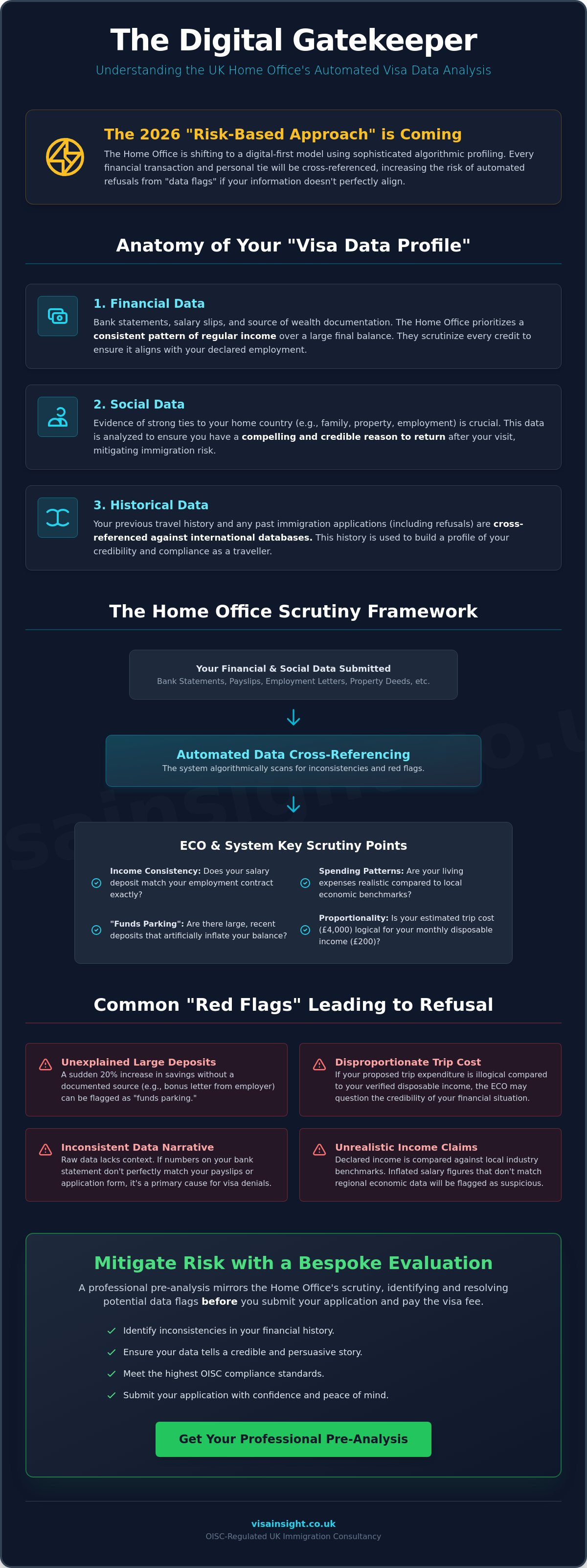
Visa data analysis is the systematic review of an applicant's financial, social, and travel data to determine their eligibility for entry. It differs significantly from the credit card data analysis used by banks to assess lending risk. While a bank looks for repayment history, the Home Office uses visa data analysis to verify the legitimacy of your intentions and the source of your funds. As we approach 2026, the UK immigration system is transitioning toward a digital-first model where automated data cross-referencing becomes the primary screening tool. This shift increases the likelihood that "data flags" will trigger automatic refusals if the information provided doesn't align perfectly with the UK Visa Policy Overview or existing government records.
An independent risk assessment is now a vital step for applicants. Identifying potential issues before submission allows for a proactive approach to compliance. Our role as an OISC-regulated consultancy is to provide a bespoke review that mirrors the scrutiny of an Entry Clearance Officer (ECO), ensuring your data tells a consistent story. This methodical approach reduces the stress of uncertainty during the processing period.
The Components of Your "Visa Data Profile"
- Financial data: This includes bank statements, salary slips, and comprehensive source of wealth documentation. The Home Office looks for patterns of regular income rather than just a high final balance.
- Social data: Evidence of ties to your home country, such as India, Italy, or France, is scrutinized to ensure you have a compelling reason to return.
- Historical data: Your previous travel history and any past immigration refusals are cross-referenced against international databases to assess your credibility.
Why Raw Data is Often Misinterpreted by ECOs
Raw data lacks context, and without a clear explanation, an ECO may interpret a legitimate financial transaction as a breach of rules. For example, a 20% increase in your savings from a legal bonus might be flagged as "funds parking" if the source isn't explicitly documented with a letter from your employer. Inconsistent data across different application sections is a leading cause of visa denials. Visa Data Analysis is the objective scrutiny of an applicant’s financial credibility against Appendix V rules. We help you present a tailored evidence pack that addresses these risks, providing the clarity needed for a seamless application process.
How the Home Office Analyzes Your Financial Data
The Home Office has transitioned toward a sophisticated model of visa data analysis to evaluate financial credibility. Case workers no longer just look at the final balance; they examine the narrative of your financial life over a sustained period. This involves a rigorous check of income consistency where every credit must align with your payslips and employment contract. If you claim a monthly salary of 150,000 PKR in Pakistan, but your bank statement shows irregular deposits of 500,000 PKR, the discrepancy triggers an immediate red flag. The system is designed to identify "funds parking," where large sums appear shortly before an application to artificially meet maintenance requirements.
Under the Immigration Rules Appendix Finance, the Home Office requires clear evidence that funds are genuinely available to the applicant. They use local economic benchmarks to assess whether your declared income is realistic for your specific sector and region. In countries like Bangladesh, this means comparing your data against average industry wages to detect inflated figures. They also scrutinize spending patterns to determine your actual disposable income. If your daily living expenses appear suspiciously low compared to local inflation rates, the Home Office may question the authenticity of your financial profile.
The Scrutiny of Bank Statements
Entry clearance officers typically review the last 90 to 180 days of transactions to identify unusual activity. A critical metric is proportionality. If your estimated trip cost is £4,000 but your monthly disposable income is only £200, the Home Office will likely conclude the expenditure is not logical. In 2024, data errors frequently arise from non-digitized records in Jamaica or regional banks in India. These inconsistencies often lead to mandatory verifications that delay processing by 15 or more working days. It's essential that every transaction is transparent and supported by evidence.
Digital Verification and Third-Party Data
Modern applications rely on automated verification systems that link directly with financial institutions to check the authenticity of documents. Through the Five Eyes intelligence alliance, the UK shares data with the US, Canada, Australia, and New Zealand to verify your global travel and financial history. Your digital footprint, including professional profiles, must match your paper application perfectly. Ensuring your documentation is robust requires a bespoke approach to financial evidence to prevent avoidable refusals. Our OISC regulated consultants provide the expert-led guidance needed to align your digital and physical data with Home Office expectations.
Risk Assessment vs. Automated Refusals: The Scrutiny Framework
The Home Office's 2026 risk-based approach relies on a sophisticated framework designed to filter applications before they reach a human desk. This process uses visa data analysis to assign a risk rating to every applicant based on their nationality, age, and travel history. If your profile matches historical patterns of non-compliance, the system flags you for enhanced scrutiny. It's vital to understand that an algorithmic flag isn't an automatic refusal. Instead, it serves as a prompt for the Entry Clearance Officer (ECO) to dig deeper into specific areas of your financial or personal history, looking for inconsistencies that suggest a lack of credibility.
The use of a secretive Home Office algorithm has become a central pillar of the UK's border strategy, prioritizing cases for intensive review based on data-driven risk profiles. For many, the instinct is to show as much money as possible in their accounts. In the current regulatory environment, however, data transparency carries more weight than high account balances. A sudden influx of funds without a documented source triggers "financial misrepresentation" flags. We've seen that a modest, well-documented balance is more successful than a large, unexplained sum that doesn't align with your declared income.
Regional Data Trends: India, Pakistan, and Nigeria
Applicants from high-volume regions like India, Pakistan, and Nigeria face specific data-driven hurdles. The Home Office monitors local economic volatility and currency fluctuations, such as the 2024 and 2025 devaluations of the Naira and Rupee, to assess whether an applicant's financial standing is genuinely stable. Common UK visitor visa refusal reasons often stem from a failure to account for these regional patterns or providing "lumpy" bank statements that don't match typical salary cycles in those countries. You must provide context for your income that aligns with local economic realities while proving your ability to sustain yourself in the UK without recourse to public funds.
Human vs. Machine: The Entry Clearance Officer’s Role
The algorithm's reach ends where human judgment begins. While the machine identifies patterns and outliers, the ECO applies the "balance of probabilities" test mandated by UK immigration law. This legal standard means the officer must believe it's more likely than not that you're a genuine visitor who will depart at the end of your stay. Data analysis must be paired with a compelling narrative to be successful. Your financial data provides the evidence, but your cover letter and supporting documents provide the context that satisfies the ECO’s professional judgment. Our bespoke approach ensures that your data tells a consistent, credible story that addresses these algorithmic flags before they lead to a refusal.
- Algorithmic Flag: A digital marker indicating a data point (like an unusual deposit) requires manual investigation.
- ECO Judgment: The final decision made by a human officer based on the evidence provided.
- Data Transparency: The clear, traceable history of your financial and personal information.
Preparing Your Data for a Successful UK Visitor Visa Application
Successful applications in 2026 rely on more than just gathering the right documents. You need to conduct a rigorous visa data analysis of your own records before the Home Office does. Start by auditing your bank statements for any anomalies. Large, unexplained transfers often lead to immediate refusals because they look like "funds stuffing." If you've received a gift or sold an asset, you must provide the paper trail. Your financial data should clearly reflect your standard of living. If your monthly disposable income is £500 but you plan to spend £4,000 on a one-week holiday, entry clearance officers will likely deem the expenditure disproportionate to your circumstances.
A bespoke cover letter acts as your data roadmap. It's your opportunity to explain why your travel history matches your previous visa stamps and to clarify any nuances in your employment history. Don't leave the caseworker to guess. If there's a gap in your data, explain it clearly and back it up with evidence. This proactive approach builds trust and reduces the likelihood of a refusal based on a misunderstanding of your personal files.
Data Consistency Checklist
Accuracy is the cornerstone of UK immigration compliance. Small errors can lead to significant delays. Ensure your data aligns across all platforms by following these steps:
- Salary Matching: Verify that the net pay on your bank statement aligns perfectly with your payslips and tax returns. Even a £10 discrepancy can trigger a request for more information.
- Liquid Funds: Ensure your "cost of trip" calculation matches your available liquid funds. Caseworkers don't count illiquid assets like pending insurance payouts as available cash.
- Silent Data: Identify assets that don't appear on a bank statement. Property ownership or family ties in Italy or Spain serve as vital proof of your intention to leave the UK at the end of your visit.
Addressing Previous Refusals via Data
If you've been refused before, your 2026 application must use data to show a genuine change in circumstances. Full disclosure is mandatory. Hiding a past refusal is often flagged as "deception" under General Grounds for Refusal, which can lead to a 10 year ban. Instead, use your data to prove the previous concerns are mitigated. For example, if a previous refusal cited "insufficient ties," provide updated property deeds or a new long-term employment contract. For those applying from specific regions, our guide on how to apply for an England tourist visa from India offers specific document tips for high-volume routes.
A thorough visa data analysis of your previous refusal letter will reveal the exact metrics you failed to meet. Address these points directly with new, verifiable data points. This methodical approach demonstrates that you're a low-risk applicant who respects the UK's regulatory environment. If you're concerned about how your financial history might be interpreted by the Home Office, you can book a professional document review with our OISC-regulated advisors to ensure your data narrative is airtight.
Visa Insight’s Bespoke Risk Evaluation: Data Analysis for Peace of Mind
Applying for a UK visa in 2026 involves navigating a landscape where automated systems and human caseworkers scrutinize every data point. A single inconsistency in a bank statement or a lack of clarity regarding your socio-economic status can lead to an immediate refusal. Our professional visa data analysis service provides a necessary layer of protection. For a fixed fee of £119, we conduct a meticulous "pre-analysis" of your documentation to ensure your data aligns with current Home Office expectations.
Our process is designed for speed and precision. We move from raw data to a comprehensive risk report within 48 hours. This rapid turnaround allows you to identify and rectify potential red flags before they reach a caseworker's desk. Relying on self-assessment is often risky because applicants lack access to the internal logic used by immigration authorities. We act as a steady, expert hand, translating complex regulatory requirements into clear, actionable insights. By the time you submit your final application, you'll have the confidence that your data tells a consistent, truthful story.
What’s Included in Your Risk Assessment Report
Every bespoke report focuses on the high-risk areas that trigger a significant portion of standard refusals. We perform a detailed evaluation of your financial consistency, specifically looking for signs of "funds parking." This involves checking if large deposits match your declared income sources, as unexplained wealth is a primary reason for rejection. Additionally, we analyze your "ties to home country" by reviewing your socio-economic data, including property ownership and employment history. You'll receive a list of specific, actionable steps to strengthen your application, such as providing additional evidence for non-salary income or clarifying family dependencies.
The Value of an Independent Expert Review
Independent reviews uncover "hidden" risks that most applicants overlook. For example, a caseworker might interpret a dormant savings account or a specific pattern of international transfers differently than you do. Our OISC-regulated consultants provide the reassurance of a meticulously prepared report that mirrors the scrutiny of the Home Office. This proactive approach transforms a stressful process into a structured journey toward success. We don't just point out errors; we provide the context needed to fix them. Don't leave your future to chance. You can get your personal UK visa risk report today and submit your application with total confidence.
Strategic Preparation for Your 2026 UK Visa Submission
The Home Office's transition toward advanced digital scrutiny for 2026 means your financial records and personal history face unprecedented levels of technical review. Understanding the mechanics of visa data analysis is now a critical component of a successful application strategy. Automated risk frameworks and the scrutiny framework used by immigration officers prioritize data consistency and transparency above all else. Failing to address potential discrepancies in your financial credibility before submission can lead to avoidable refusals based on perceived risk rather than actual eligibility.
You shouldn't navigate these complex legal hurdles without expert guidance. Visa Insight offers a steady hand through this turbulent regulatory environment. Our OISC-registered professionals provide an independent evaluation of your financial credibility, ensuring every document meets strict compliance standards. We deliver a bespoke risk report within 48 hours, providing the clarity you need for a seamless application process. This methodical approach transforms uncertain legal outcomes into a predictable, step-by-step path toward your goals.
Secure your application with a professional Visa Risk Assessment for £119
Taking proactive control of your data today ensures you're prepared for the rigorous standards of the UK immigration system. We're committed to your success and look forward to partnering with you on this journey.
Frequently Asked Questions
How does the Home Office perform data analysis on bank statements?
The Home Office utilizes automated verification systems to cross-reference your transaction history with reported income levels. Since 2024, digital tools have allowed caseworkers to identify patterns like "funds padding" within seconds. They analyze the frequency of deposits and the source of every credit exceeding £500. If your spending habits don't align with your declared salary, the system flags the application for a manual review by an entry clearance officer.
Can a "large deposit" lead to a visa refusal even if the money is mine?
A large deposit can lead to a refusal under Appendix Finance rules if the source of funds isn't clearly evidenced. Caseworkers look for irregular spikes where an applicant's balance increases significantly just before applying. For example, a single deposit exceeding 25% of your total required savings requires a formal letter of explanation or a gift deed. Without this documentation, the Home Office often concludes the money isn't genuinely available to you.
Does the UK government use AI or algorithms to analyze visa data?
The Home Office employs sophisticated visa data analysis through its Streaming Analytics engine to categorize applications by risk level. This algorithmic approach sorts cases into green, amber, or red streams based on historical compliance data from your country of origin. By 2026, these systems will integrate more real-time financial data. While an algorithm might flag a discrepancy, a human caseworker still makes the final decision on whether to issue a refusal notice.
What is the most common data error that leads to a UK visitor visa refusal?
The most frequent error is a discrepancy between the monthly living costs stated on your application and the actual debits shown on your bank statements. Data from 2023 indicates that over 30% of visitor visa refusals under Paragraph V 4.2 cited financial credibility issues. If you claim to spend £200 monthly but your statements show £800 in regular outgoings, the caseworker will likely doubt the accuracy of your entire submission.
How far back does the Home Office look at my financial data?
Standard requirements mandate the submission of the most recent 3 to 6 months of financial records. However, under the 2026 compliance framework, caseworkers have the authority to request up to 12 months of data if they suspect irregular patterns. It's vital that your closing balance has remained above the required threshold for at least 28 consecutive days. Any dip below this amount, even for a single day, results in an automatic failure of the financial requirement.
Is my personal data safe when using an independent risk assessment service?
Your personal data is protected by strict UK GDPR regulations and Data Protection Act 2018 standards when you use an OISC-registered firm. Professional consultancies use 256-bit encryption to secure your financial documents during the assessment process. At Visa Insight, our OISC registration ensures we handle your sensitive information with the same level of confidentiality as a legal practice. We delete all primary source documents within 90 days of concluding your bespoke case assessment.
How can I explain inconsistent data in my UK visa application?
You should address inconsistencies through a formal Letter of Representation that provides a chronological explanation of the conflicting data points. If your visa data analysis reveals a gap in employment or a sudden change in income, you must provide secondary evidence like tax returns or employer contracts. Clear, numbered appendices help the caseworker navigate your explanation. This proactive approach prevents the Home Office from making negative assumptions about your financial stability.
What should I do if my visa data analysis shows a high risk of refusal?
If an assessment identifies a high risk, you should postpone your submission until you can demonstrate a stable financial history. This often involves maintaining the required funds for a new 90-day period or obtaining missing documentation for past transactions. Our OISC-regulated advisors provide a tailored roadmap to move your application from a high risk to a compliant status. It's much more cost-effective to fix data errors now than to challenge a refusal later.