

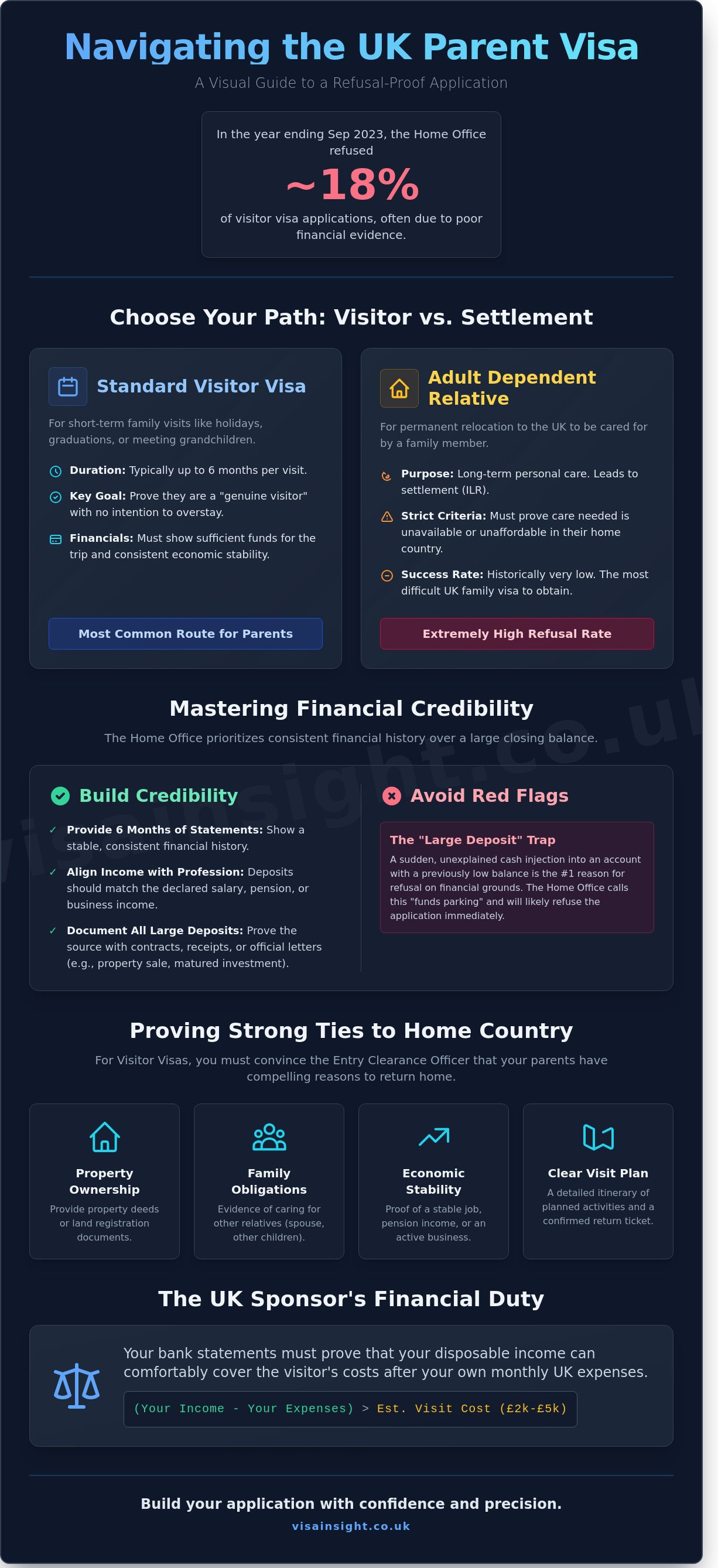
Did you know that in the year ending September 2023, the Home Office refused nearly 18% of visitor visa applications from specific regions, frequently citing a lack of financial credibility? You're likely feeling the weight of these statistics as you plan a parents visa for uk. It's stressful to decipher whether your family needs a Standard Visitor route or the more permanent Adult Dependent Relative path, especially when a single mistake results in losing non-refundable fees. You deserve a clear path that respects your time and financial commitment.
This guide provides a meticulous roadmap to navigate the 2026 immigration rules with the precision of an expert consultant. We'll help you build a refusal-proof application by focusing on rigorous financial documentation and proving "strong ties" to the home country. By the end of this article, you'll have a logical, step-by-step framework to choose the right route and submit your application with absolute confidence in its compliance. Our bespoke insights ensure you don't just apply, but succeed in bringing your family together.
Key Takeaways
- Distinguish between Standard Visitor and settlement routes under Appendix FM to select the most appropriate pathway for your family’s specific circumstances.
- Learn to demonstrate genuine financial credibility and avoid the common "Large Deposit" trap that often triggers immediate Home Office refusals.
- Strengthen your parents visa for uk application by providing precise itineraries and robust evidence of enduring economic ties to your parents' home country.
- Understand region-specific requirements for India and Pakistan, including how to document property ownership and family obligations to satisfy local VFS Global standards.
- Identify critical "red flags" through a bespoke risk assessment to mitigate the financial and emotional impact of a visa rejection before paying government fees.
Navigating UK Parent Visa Routes: Visitor vs. Settlement in 2026
Understanding the options for a parents visa for uk requires a clear distinction between temporary stays and permanent relocation. The UK immigration policy has undergone significant shifts following the April 2024 rule changes, making the distinction between Appendix V (Visitors) and Appendix FM (Family Members) more critical than ever. Many applicants mistakenly conflate the "Parent of a Child" route with the ability to bring elderly parents to the UK. While the former focuses on parents of British minors, the latter falls under the Adult Dependent Relative (ADR) category.
The ADR visa remains the most challenging category to secure within the Home Office framework. Success rates are historically low because the applicant must prove they require a level of long-term personal care that's unavailable or unaffordable in their home country. For families in India, Pakistan, and Bangladesh, the Home Office often rejects these applications by arguing that local care or private nursing is accessible. Our OISC regulated consultants provide bespoke assessments to determine if your specific circumstances meet these rigid standards. We focus on building a comprehensive evidence base to address these high refusal rates directly.
The Standard Visitor Visa for Parents
This route is the primary choice for short-term stays of up to six months. It's the ideal solution for attending a child's graduation, visiting a newborn, or spending the winter months with family. The Entry Clearance Officer (ECO) focuses heavily on "genuine visitor" status. While parents from the US, Hong Kong, or Europe often experience a more streamlined process, applicants from South Asia must provide robust evidence of their ties to their home country. You'll need to prove they've no intention of overstaying. We recommend providing a tailored schedule of their planned activities to demonstrate a clear purpose for the visit.
The Family Visa: Parent of a British Child
This settlement route is specifically for parents whose children are British or Irish citizens residing in the UK. It's not a general parents visa for uk for elderly relatives. To qualify, you must demonstrate sole parental responsibility or show that the other parent is a British citizen who isn't your partner. The Home Office enforces strict financial and English language thresholds for this path. Unlike visitor visas, this route allows for a stay of 2.5 years, leading eventually to Indefinite Leave to Remain (ILR). It requires a meticulous approach to compliance and documentation to ensure a seamless transition into UK life.
The UK Standard Visitor Visa for Parents: Financial Credibility
Establishing financial credibility for a parents visa for uk involves more than showing a high closing balance. Entry clearance officers look for the "economic reality" of the applicant's life. It's a common mistake to assume that having £10,000 in a bank account on the day of the application guarantees success. Instead, the Home Office examines the history of those funds to ensure they're genuinely available. If a bank statement shows a sudden injection of £4,000 into an account that usually maintains a balance of £200, it's flagged as a "large deposit." Without a documented source, such as a property sale contract or a matured fixed deposit receipt, this leads to an immediate refusal under the official UK Immigration Rules. The Home Office suspects "funds parking," where money is temporarily borrowed to create a false impression of wealth.
Consistency is the priority for parents applying from India, Pakistan, or Nigeria. As of 2024, caseworkers scrutinize the 180-day history of every account provided. They check if the monthly deposits align with the parent's declared profession or pension. If your mother claims to be a retired teacher in Lagos but her account shows irregular, large cash deposits from unknown sources, her credibility is compromised. The UK sponsor's role is equally vital. Your bank statements don't just prove you can afford the trip; they validate the narrative of the application. If you're providing full maintenance, your disposable income must comfortably cover the estimated £2,000 to £5,000 cost of the visit after your own UK monthly expenses are met.
Proving Sustainable Income and Savings
The Home Office expects 6 months of bank statements that correlate perfectly with pension slips or business tax returns. In cash-heavy economies like Bangladesh or Jamaica, where 35% of income might be unbanked, this is challenging. Parents should deposit cash income regularly to create a traceable paper trail at least 6 months before applying. Vague claims of "agricultural income" without land ownership records or mandi receipts won't suffice for a parents visa for uk.
Sponsorship and Maintenance Undertakings
A bespoke sponsorship letter is a legal cornerstone of the application. It must detail the specific accommodation arrangements, confirming there's enough space for the parents without overcrowding the property. You must prove you can provide support without your parents needing "recourse to public funds." Relying on "Third Party Support" from friends or distant relatives is risky, as the Home Office often doubts the legal obligation of the donor. For a bespoke assessment of your financial documents, our OISC-regulated consultants can ensure your sponsorship package meets the highest standards of compliance.
Common Refusal Triggers for Parent Visas: The "Credibility" Gap
Securing a parents visa for uk requires far more than a simple family connection. The Home Office frequently issues refusals based on a perceived lack of "credibility," a term used when an applicant's profile fails to align with the strict requirements of Appendix V: Visitor. Vague travel plans are a primary catalyst for these rejections. Simply stating a parent is "visiting family" isn't enough to satisfy a case worker. An application needs a granular, date-specific itinerary. This should include specific events, such as a 70th birthday celebration on October 12 or a graduation ceremony in July, rather than an undefined multi-month stay.
Economic ties serve as the cornerstone of a successful application. If a parent resides in a region where average wages are significantly lower than those in the UK, the Home Office often starts with the assumption that the applicant intends to overstay for work. Past immigration history also carries immense weight. A refusal for a US B1/B2 visa in 2021 or a Schengen rejection from 2023 will be visible to UK authorities through international data-sharing agreements. Failing to disclose these prior setbacks is often viewed as a "mandatory refusal" under General Grounds for Deception, which can lead to a 10-year ban from the UK.
The "Intention to Leave" Hurdle
Retirement is frequently a double-edged sword in the eyes of entry clearance officers. While it provides the freedom to travel, the Home Office views a retired parent as having fewer "incentives to return" compared to someone with a full-time career. For parents residing in countries like Pakistan, Italy, or Spain, the burden of proof rests on demonstrating "Strong Ties" to their home nation. This is particularly challenging for widowed or single parents. While the official UK government guidance on parent visas focuses on those seeking to live in the UK long-term, visitor applicants must prove their stay is strictly temporary. We recommend providing evidence of property ownership, a 12-month pension history, or documented medical commitments that require their presence back home.
Documentary Inconsistencies
Small errors often derail a parents visa for uk application before it's even fully reviewed. A mismatch between the flight dates mentioned in a cover letter and those entered on the online form is a common red flag. Translation errors also pose significant risks. Documents from France, Germany, or Serbia must be translated by a certified professional to avoid the misinterpretation of financial terms. Using generic templates is dangerous; each application needs a bespoke approach that reflects the parent's unique financial and social circumstances. In 2023, approximately 18% of visitor visa refusals cited inconsistencies between bank statements and declared income as a primary factor in the decision.
Country-Specific Guidance: Proving Strong Ties in 2026
The Home Office doesn't apply a universal standard to every application. Local visa processing centers, managed by commercial partners like VFS Global and TLScontact, use localized intelligence to assess the risk of overstaying. When you apply for a parents visa for uk, the evidentiary burden shifts based on the applicant's country of residence. In 2026, entry clearance officers focus heavily on economic pull factors versus social push factors. Our role as OISC-registered advisors is to ensure your evidence outweighs any perceived risk of non-return.
Strategies for India, Pakistan, and Bangladesh
For parents in South Asia, property ownership remains the gold standard of proof. We recommend submitting certified Land Registry documents or the Parivar Pehchan Patra (Family ID) where available, as these provide a verifiable link to a permanent residence. If your parents work in the informal or agricultural sectors, traditional tax returns might not exist. In these specific cases, we utilize bespoke witness statements from local authorities or 12 months of consistent bank statements showing local trade. Social standing, such as holding a position in a community trust or religious organization, serves as a powerful non-financial tie that proves a commitment to return home after the visit.
Context for Europe and the Americas
It's a common misconception that parents from "low-risk" countries like the US, Italy, or France face no scrutiny. Since the full implementation of the UK's Electronic Travel Authorisation (ETA) system in 2025, the Home Office tracks movement patterns with 99% accuracy. For an American or EU-based parent, the risk isn't usually financial instability; it's the suspicion of "de facto" residency. If a parent spends five months in the UK, returns home for a few weeks, and attempts to re-enter, they'll likely face a refusal under Paragraph V 4.2 of the Visitor Rules. You must prove they maintain an active life abroad through property tax receipts, such as the Imposta Municipale Propria (IMU) in Italy, or active healthcare enrollments that require their physical presence.
- Nigeria and Hong Kong: Focus on business ownership and active directorships. The Home Office often scrutinizes the source of funds for large, one-off deposits in these regions.
- Employment Ties: For parents still in the workforce, a letter on headed paper confirming the specific date they're expected back at work is essential for compliance.
- Digital Footprint: Ensure all social and economic ties mentioned in the application are consistent with any public professional profiles, such as LinkedIn or local business registries.
Eliminating Risk: How Visa Insight Evaluates Your Parent’s Application
Standard OISC advice provides a foundation for compliance, but it often stops at basic eligibility. Our independent risk assessment bridges the gap between following a checklist and passing the rigorous scrutiny of a Home Office caseworker. We've developed a professional evaluation process that identifies "red flags" before you commit to the non-refundable government fee. It's a proactive strategy designed to save you from the disappointment of a preventable refusal. Our £119 report offers an expert second opinion that mirrors the logic used by Entry Clearance Officers.
Efficiency is central to our digital consultancy. We provide a 48-hour turnaround because we understand that family travel plans are often time-sensitive. This rapid delivery doesn't compromise on depth; instead, it reflects our mastery of UK immigration law. By using a structured credibility check, we offer the most bespoke way to prepare your parents' documentation. You aren't just buying a document; you're gaining a professional partner to navigate a complex regulatory environment.
Our Methodology: The Risk Evaluation Report
We analyze financial consistency using the exact logic employed by the Home Office. When you're preparing a parents visa for uk, small discrepancies in bank statements can lead to immediate rejection. Our team scrutinizes "Strong Ties" and "Intention to Leave" claims with a skeptical eye. We look for evidence of property ownership, local pension ties, or family responsibilities that prove your parents will return home. If we find a weakness, we don't just point it out. We provide a clear, actionable roadmap to fix these gaps before your final submission.
Protecting Your Family’s Future in the UK
The cost of a refusal is significantly higher than the initial visa fee. A rejection stays on a person's immigration record permanently, which can trigger additional scrutiny for every future visit. For parents traveling from high-scrutiny regions where refusal rates can be statistically higher, a robust case is a necessity rather than a luxury. We focus on building a narrative of compliance and transparency. Our goal is to make the process seamless, ensuring your family can focus on their visit rather than legal hurdles. Take the first step toward a successful application and Get your bespoke Parent Visa Risk Assessment for £119 to secure your family's travel plans.
Navigating Your Parent’s UK Visa Path with Precision
Securing a parents visa for uk in 2026 demands a meticulous approach to financial credibility and home ties. The Home Office’s intense focus on the "credibility gap" means that even minor inconsistencies in bank statements often lead to an immediate refusal. Success hinges on presenting a bespoke narrative that aligns with current OISC standards and addresses specific risks encountered by families in India, Pakistan, and Nigeria. You don't have to navigate these complex regulatory requirements alone; expert guidance ensures your application reflects the highest level of legal compliance.
Visa Insight provides the professional clarity needed to overcome these hurdles. Our team delivers a comprehensive Risk Assessment report within 48 hours, offering an expert analysis of your financial standing and potential refusal triggers. This tailored evaluation is designed to eliminate uncertainty and build a robust case for your family's reunion. Secure your parents visa success with a bespoke Risk Assessment report for £119. We're committed to helping you bring your family together with confidence and integrity.
Frequently Asked Questions
How much money is required in the bank for a UK parent visitor visa?
The Home Office doesn't specify a fixed minimum balance, but you must demonstrate sufficient funds to cover the estimated costs of the trip, typically ranging from £2,000 to £5,000 depending on the duration. Applicants must provide six months of bank statements to show financial stability and the source of funds. If you're sponsoring, your own financial standing is equally scrutinised to ensure you can support them without recourse to public funds.
Can I sponsor my parents to live in the UK permanently in 2026?
Sponsoring a parent for permanent residence in 2026 requires meeting the strict Adult Dependent Relative (ADR) criteria, which carries a high refusal rate of over 90% in recent years. You must prove they require long-term personal care for daily tasks that's unavailable or unaffordable in their home country. This route is distinct from a standard parents visa for uk visit, as it grants indefinite leave to remain rather than a temporary stay.
What are the most common reasons for UK parent visa refusals in India?
The most frequent reason for refusal in India is a lack of evidence regarding "strong ties," often cited under Paragraph V 4.2 of the Immigration Rules. Entry clearance officers frequently flag large unexplained deposits in bank accounts that don't match the applicant's declared income profile. In 2023, data suggested that inconsistent financial documentation remained the primary hurdle for Indian applicants seeking to visit family in the UK.
Does my parent need to take an English language test for a visitor visa?
Your parents don't need to take an English language test for a standard visitor visa application. Language requirements only apply to long-term settlement routes or work visas, not for those visiting for six months or less. This simplifies the eligibility process, allowing elderly parents to focus on providing evidence of their intent to return home rather than academic proficiency.
How long does a UK parent visa application take to process?
A standard application for a parents visa for uk typically takes 15 working days to process once the biometrics are submitted at a visa application centre. If you require a faster decision, the Home Office offers a priority service for an additional £500, which usually provides a result within 5 working days. We recommend applying at least 8 weeks before the intended travel date to account for seasonal delays.
What counts as "strong ties" to the home country for an elderly parent?
Strong ties for an elderly parent include documented ownership of property, receipt of a state or private pension, and deep family connections in their home country. You should provide a minimum of three distinct pieces of evidence, such as land deeds or medical records indicating ongoing local treatment. Showing that other children or grandchildren live nearby provides a clear incentive for them to return after their visit.
Can I appeal a UK parent visa refusal?
There's no statutory right of appeal for a visitor visa refusal unless there's a human rights claim involved. If a parent's application is rejected, the most effective path is usually a fresh application that addresses the specific concerns raised in the refusal letter. In complex cases, a Judicial Review may be considered, but this is a legal process that requires expert OISC regulated guidance to navigate correctly.
Is a cover letter mandatory for a UK parent visa application?
While a cover letter isn't a mandatory requirement under the UK Immigration Rules, it's a vital component of a successful bespoke application. A well-crafted letter allows you to explain the purpose of the visit and clarify any complex financial transactions that might otherwise trigger a refusal. It acts as a roadmap for the caseworker, ensuring all supporting documents are viewed in the correct context for a seamless assessment.