

Did you know that a single undisclosed traffic penalty from five years ago can lead the Home Office to refuse your application for british citizenship? It's a sobering reality for many who assume their long-term residency makes naturalisation a mere formality. You've likely invested years into your UK career and community, yet the prospect of managing the complex naturalisation process feels like a high-stakes gamble. It's common to feel overwhelmed by the strict 450 day absence limit or the subjective nature of the good character test.
Visa Insight provides a bespoke roadmap to help you secure your British passport with confidence. This guide offers a comprehensive breakdown of the 2026 residency requirements and the technical nuances of the good character requirement. We'll explore the specific evidence needed to meet OISC regulated standards for a seamless submission and discuss how dual nationality might affect your original status. You'll gain a clear, step-by-step path to achieving a successful outcome and finally securing your future in the UK.
Key Takeaways
- Gain a comprehensive understanding of the British Nationality Act 1981 to identify the most secure legal route for your transition from resident to national.
- Identify the precise statutory requirements regarding age and physical presence in the UK to ensure your eligibility is beyond dispute before you apply.
- Uncover the nuances of the "Good Character" test and learn how to mitigate the risks associated with this subjective and high-stakes Home Office requirement.
- Learn how to strategically time your british citizenship application, including the critical 12-month period required after securing Indefinite Leave to Remain.
- Navigate the final administrative hurdles with a clear roadmap for completing Form AN, managing fees, and successfully attending your biometric appointment.
Understanding British Citizenship: Routes and Eligibility in 2026
British naturalisation is the formal legal procedure through which a non-UK national acquires the same status and rights as those born in the United Kingdom. This transition is governed primarily by the British Nationality Act 1981, which serves as the definitive framework for British nationality law. While citizenship by birth is often an automatic right for those born to British parents or settled residents, naturalisation is a discretionary grant. It requires a meticulous application process to prove you've met specific residency and character requirements set by the Home Office.
The year 2026 represents a pivotal moment for thousands of residents. It marks exactly five years since the June 30, 2021 deadline for the EU Settlement Scheme (EUSS). Consequently, the surge of European nationals who secured Settled Status at that time have now completed the mandatory 12-month waiting period required after receiving Indefinite Leave to Remain. This year signals a period of relative stability in residency rules following the post-Brexit transition, allowing for a more predictable and seamless british citizenship application process for those who've built their lives in the UK.
Common Routes to Naturalisation
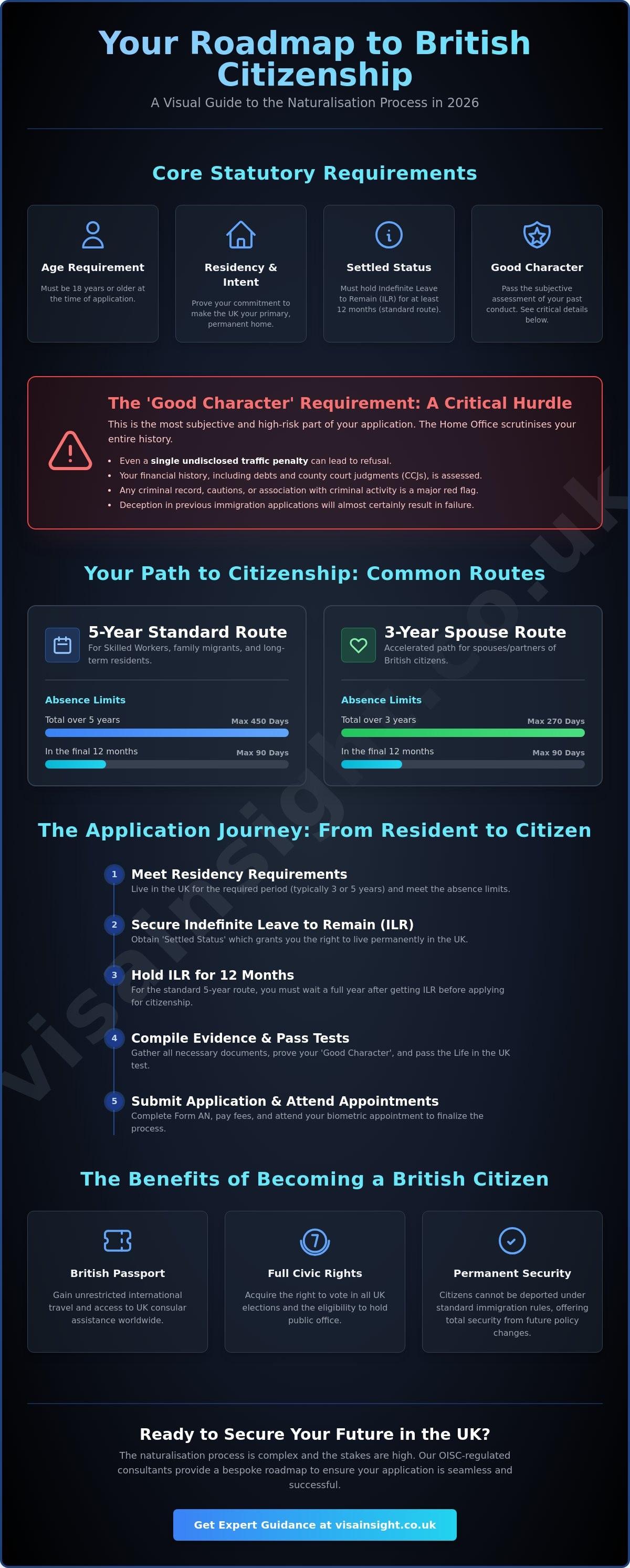
The path you take depends largely on your current immigration status and your relationship to British nationals. Most international professionals and family migrants utilize the standard five-year residency route. This requires five years of continuous residence in the UK, with no more than 450 days spent abroad during that period. For those married to or in a civil partnership with a British citizen, a three-year route is available, which waives the requirement to hold permanent residency for a full year before applying.
- The 5-Year Route: The standard path for Skilled Worker visa holders and most family migrants who've held Indefinite Leave to Remain for at least 12 months.
- The 3-Year Spouse Route: An accelerated track for partners of British citizens, provided they hold settled status on the date of application.
- Special Provisions: Bespoke pathways exist for individuals with Windrush backgrounds or those holding EU Settled Status, ensuring historical and treaty-based rights are fully protected during their british citizenship journey.
The Legal Benefits of Becoming a Citizen
Acquiring citizenship provides a level of permanence that Indefinite Leave to Remain cannot match. It offers total security from future changes in Home Office policy or immigration law, as citizens cannot be deported under standard immigration rules. Once naturalised, you gain the right to vote in all UK general and local elections and the eligibility to hold public office. You're also entitled to a British passport, which facilitates unrestricted international travel and access to UK consular assistance abroad. Our OISC-regulated consultants provide tailored guidance to ensure your application is compliant with the latest 2026 regulations, turning a complex legal hurdle into a successful milestone.
The Core Statutory Requirements for Naturalisation
To qualify for british citizenship, you must be at least 18 years old at the point of application. The Home Office also mandates a 'future intent' requirement, where you demonstrate a commitment to making the UK your primary residence. This isn't merely a box-ticking exercise; it's a legal declaration of your long-term loyalty to the British state. Our OISC-registered consultants frequently observe that the Home Office scrutinizes this intent if an applicant maintains significant financial or residential ties elsewhere while spending minimal time in the UK.
While many applicants focus on technical paperwork, understanding the legal nuances of the 'good character' requirement is equally vital. You can find comprehensive guidance on becoming a citizen which outlines how past conduct, including financial history and minor legal infractions, influences your eligibility. This assessment is subjective, making professional oversight essential for those with complex backgrounds.
Calculating Your Absences from the UK
Precision is mandatory when documenting your time away from the country. For those on a standard five-year route, you can't exceed 450 days of absence across the entire period. The final 12 months before your application are subject to a stricter 90-day limit. For professionals from India or the USA who travel frequently for corporate engagements, meticulous record-keeping is essential. We recommend cross-referencing digital boarding passes with HMRC records to ensure every 24-hour absence is accounted for accurately. If you've exceeded these limits due to unavoidable business travel or family emergencies, specific discretions may apply, though these require a robust legal argument.
Proving Language Proficiency and Cultural Knowledge
Meeting the English language requirement involves achieving at least a B1 level on the Common European Framework of Reference for Languages (CEFR). Applicants must also pass the Life in the UK test. In 2026, this exam remains a rigorous 45-minute assessment of British history, law, and values. You're exempt from these requirements if you're over 65 or have a long-term physical or mental condition. Additionally, if you hold a degree taught in English from a recognized institution in countries like Australia or Jamaica, you might not need a separate language test. If your documentation is complex, our team provides a bespoke assessment of your eligibility to ensure your submission is robust and compliant with the latest Home Office standards.
The 'Good Character' Requirement and Common Refusal Risks
The Home Office doesn't define 'good character' within the British Nationality Act 1981. It's a discretionary assessment. This subjectivity makes it the leading cause of british citizenship refusals, accounting for nearly 40% of all rejected applications in recent years. Caseworkers evaluate your conduct over the previous ten years to determine if you're a person of integrity. They don't just look for serious crimes; they look for any pattern of behavior that suggests you haven't respected the laws of the UK.
Criminality is a significant hurdle. While spent convictions under the Rehabilitation of Offenders Act 1974 are often disregarded for other purposes, they must be disclosed in nationality applications. Minor driving offences, such as speeding or using a mobile phone while driving, can lead to a refusal if they're recent or numerous. Fixed Penalty Notices (FPNs) don't automatically trigger a rejection, but failing to disclose them is viewed as a "dishonest intent," which is a mandatory ground for refusal under current Home Office Nationality Policy.
Financial integrity is equally scrutinized. The Home Office expects applicants to meet their financial obligations. This includes:
- HMRC Compliance: Outstanding tax debts or late filings can signal poor character.
- Bankruptcy: While being bankrupt isn't an automatic bar, the caseworker will investigate if the bankruptcy was "reckless" or "dishonest."
- NHS Debt: Unpaid medical fees of £500 or more are frequently flagged during the vetting process.
Previous Immigration History and Non-Compliance
Your journey to naturalisation is viewed as a single, continuous narrative. Any past "bad faith" dealings with the Home Office will resurface. If you have historical UK visitor visa refusal reasons on your record, you must address them transparently. Periods of overstaying are particularly damaging. While the Home Office may disregard short periods of overstaying in some visa categories, they're much stricter when you apply for british citizenship. Deception remains the greatest risk; if a caseworker finds that you provided conflicting information in a previous Tier 2 or Spouse visa application, they'll likely refuse the citizenship claim on the basis of dishonesty.
The Role of Referees in Your Application
Every application requires two referees to mitigate the risk of identity fraud and verify your standing in the community. One referee must be a professional person of any nationality, such as a solicitor, a civil servant, or a member of a regulated professional body. The second referee must be a British citizen who's over the age of 25. It's a bespoke requirement designed to provide a 360-degree view of your character. Common errors that cause delays include:
- Using a referee who's related to you or the other referee.
- Selecting a professional whose OISC regulation or professional status has lapsed.
- Providing a referee who hasn't known you for the required three-year period.
Our consultants often find that simple administrative errors in referee declarations lead to unnecessary scrutiny. Ensuring your referees meet the precise criteria is a vital step in maintaining the momentum of your application.
Strategic Planning: From Resident to Citizen
Transitioning from Indefinite Leave to Remain (ILR) to british citizenship requires meticulous timing and a deep understanding of residency thresholds. For most applicants, the final hurdle is the 12-month waiting period after receiving settled status. Unless you're married to a British national, you must hold ILR for a full calendar year before the Home Office will accept your naturalisation application. During this window, it's vital to ensure your current leave doesn't lapse. You must remain physically present in the UK on the date exactly five years before the Home Office receives your application.
Gathering evidence is a multi-year project that demands organized record-keeping. To satisfy the 2026 requirements, you'll need to provide a comprehensive paper trail covering your five-year qualifying period. This includes:
- Passports and travel documents covering the entire residency term.
- P60 documents or annual tax returns from 2021 through 2026.
- Employer letters confirming specific dates of international business travel.
- Utility bills or council tax statements that prove continuous physical presence.
Dual Citizenship Considerations by Country
Navigating dual nationality requires understanding your home country's specific legal framework. India doesn't permit dual citizenship under the Citizenship Act 1955. Once you acquire a British passport, you must renounce your Indian nationality, though you can apply for Overseas Citizenship of India (OCI) status to maintain lifelong travel and residency rights. Pakistan and Bangladesh generally allow dual nationality with the UK, but you must report foreign assets to local authorities to remain compliant. Applicants from the USA or EU must remain vigilant regarding tax reporting, as the IRS requires US citizens to file returns on global income regardless of where they live.
The Importance of Financial Consistency
Your financial history serves as a primary indicator of your character profile. The Home Office cross-references your naturalisation evidence with previous Skilled Worker or Spouse visa filings. If your reported income in 2026 doesn't align with the figures you provided to HMRC or the Home Office in 2023, you risk a refusal based on "Good Character" grounds. Proving your financial stability through consistent tax records and bank statements is essential for a successful outcome. Financial Credibility is the documented alignment between an applicant's reported earnings, tax contributions, and disclosed assets across all historical Home Office submissions as of the 2026 regulatory standards.
Our OISC-registered advisors provide the meticulous oversight needed to ensure your documentation is flawless and your timeline is secure. To protect your path to naturalisation, book a bespoke legal consultation with our team today.
Navigating the Application Process and Final Steps
The final path to british citizenship requires precision and a methodical approach to the Home Office's digital systems. Your journey begins with the completion of the online Form AN. This stage involves paying the application fee, which stands at £1,735 for 2026. Accuracy here is vital. Any discrepancy between your digital form and your supporting evidence can lead to immediate delays or a formal refusal.
Once you've submitted the form, you'll proceed through several critical milestones:
- Biometric Enrollment: You must book an appointment at a UKVCAS service point to provide your fingerprints and a digital photograph.
- The Review Period: The Home Office typically takes six months to process naturalisation requests. During this time, caseworkers verify your "good character" and residency history against HMRC and police records.
- The Citizenship Ceremony: After approval, you'll attend a local authority ceremony. You'll take an oath or affirmation of allegiance and receive your naturalisation certificate.
- Passport Application: The certificate allows you to apply for your first British passport, which is a separate legal process with its own fee structure.
Costs and Fee Waivers
Budgeting for british citizenship involves more than just the primary application fee. You'll also encounter costs for the £50 Life in the UK test and biometrics booking fees ranging from £0 to £200 depending on the location and time. It's essential to understand the "no refund" policy. If the Home Office refuses your application due to a failure to meet the statutory requirements, you'll lose the £1,735 fee entirely. Fee waivers exist but are strictly limited to those who can prove they're destitute or in extreme financial hardship. Our OISC-regulated advisors often recommend a bespoke pre-submission audit to protect this significant financial investment.
How to Ensure Your Foundation is Secure
Success in naturalisation often depends on the very first steps you took years ago. For instance, ensuring you followed the correct procedure for an England tourist visa from India sets a precedent for a clean immigration record. Any historic breach of visa conditions can resurface during the final review. We suggest performing a risk assessment if you have complex travel histories or past gaps in employment. Maintaining meticulous records of your absences from the UK during the final 12 months is mandatory. This high level of organization ensures your transition from permanent resident to citizen is seamless and predictable.
Securing Your Future as a British National in 2026
Navigating the path to british citizenship in 2026 requires more than just meeting the basic five-year residency threshold. Success hinges on a meticulous alignment with OISC-regulated standards and a clear understanding of the Home Office's evolving 'Good Character' requirements. While the standard processing time typically spans 6 months, a single oversight regarding past travel or financial ties can lead to an immediate refusal. It's essential to address these complexities before you submit your formal application to avoid unnecessary delays or loss of fees.
At Visa Insight, we provide a bespoke approach to your naturalisation journey. Our team delivers 48-hour risk assessment reports that offer an independent analysis of potential refusal triggers. We conduct a detailed evaluation of your financial credibility and ties to ensure every aspect of your history meets the stringent statutory criteria. To safeguard your application, identify potential risks in your immigration history before you apply. Taking this proactive step ensures you approach your citizenship ceremony with absolute confidence. Your future in the UK is a significant milestone, and we're here to ensure it's achieved with precision and peace of mind.
Frequently Asked Questions
Can I apply for British citizenship if I have a criminal record?
You can apply for British citizenship with a criminal record, but you must satisfy the strict "good character" requirement. Under Home Office guidance updated in July 2023, caseworkers usually refuse applications if you've received a custodial sentence of 12 months or more. For minor offenses, the rehabilitation period must have passed. It's essential to disclose all convictions, including driving fines, as failing to do so counts as deception.
How long does the British citizenship application take in 2026?
Most British citizenship applications are processed within six months of your biometric appointment. The Home Office aims to decide 95% of naturalisation cases within this standard timeframe. However, complex files involving residency gaps or character concerns can take longer to resolve. Our bespoke legal review ensures your evidence is comprehensive to prevent delays. You'll receive a digital notification once a senior caseworker reaches a final decision.
What happens if my British citizenship application is refused?
If your application is refused, you don't have a formal right of appeal, but you can request a reconsideration via Form NR. This internal review involves a senior official checking if the law was applied correctly to your case. Our OISC-registered consultants find that many refusals result from simple administrative errors. If this reconsideration fails, the final legal option is a Judicial Review in the Upper Tribunal.
Do I have to give up my original passport to become a British citizen?
You don't have to give up your original passport because the UK allows dual nationality under the British Nationality Act 1981. This means you can hold a British passport and your current one at the same time. However, you must check your home country's laws. Nations like India or China don't permit dual citizenship and require you to renounce your original nationality once you become a British citizen.
Can I travel outside the UK while my citizenship application is being processed?
You're free to travel outside the UK while your application is being processed, provided you maintain your "intent to reside" here. Since the Home Office uses digital records, you won't need to surrender your physical passport during the waiting period. Just ensure you're available to attend your citizenship ceremony within 90 days of receiving your approval letter. Excessive absences during this time could lead to questions about your permanent commitment.
What is the difference between ILR and British citizenship?
Indefinite Leave to Remain (ILR) is a residency status, whereas british citizenship is a permanent legal standing that isn't easily revoked through absence. If you stay outside the UK for more than two consecutive years, your ILR status usually expires automatically. Citizenship grants you a British passport and the right to vote in all elections. It also ends the requirement for further immigration compliance or Home Office monitoring.
Is the Life in the UK test still required for people over 65?
You don't need to take the Life in the UK test or meet the English language requirement if you're aged 65 or over. This age-based exemption is a fixed rule in the naturalisation process. You'll need to provide a valid passport or birth certificate to confirm your date of birth. Applicants with permanent physical or mental health conditions can also seek a medical waiver by submitting form Appendix KoLL.
How much does British citizenship cost in total for an adult applicant?
The total Home Office fee for a british citizenship application for an adult is currently £1,630. This amount includes the £80 fee for your citizenship ceremony, which is a mandatory part of the process. You'll also need to pay £19.20 for your biometric enrollment at a UKVCAS center. These government fees are subject to change every April, so it's vital to check the latest figures before you submit.